

What Happens When Intelligence Becomes Cheap?
If intelligence becomes infinite, do we lose our sense of value for thinking?

Reading has never come naturally to me. I will spend months on the same book. I stop, return, question, annotate, and then, an hour later, lose interest entirely. Somewhere between effort and impatience, I end up asking the same question each time: what is the point?
Similarly, I was halfway through the book, These Strange New Minds by Christopher Sommerfield, and just like every time, I was stumped. There was too much theory and not enough action to do with it.
I skimmed back through the past three chapters I had read, and my attention was drawn to one line:
"The thing about AI systems is they know how to reply, but they don't know what the queries are about."
Cool. What can I do about it?
Thinking back to my last article, I started to wonder, rather than answering… “Can AI think?”
The more useful question was: “What happens when AI becomes embedded in collective human cognition?”
At first, I dismissed the question. AI is a population-level shift.
Most of the advice I hear sounds frustratingly individual. Read the book. Do the hard thing. Think for yourself. It is difficult to hear that without some resentment when everyone else is outsourcing everything and appears to be gaining advantages endlessly. I was not willing to submit to unnecessary difficulty simply because it sounded virtuous, without actually believing why. I needed to understand the second-order effects of outsourcing before I stopped.
Intelligence is beginning to feel like buffet food.
Intelligence is beginning to resemble abundance in its least flattering form. Not abundance as liberation, but abundance as excess. You need a combination of abundance and appreciation in order to live a useful life, which is why spiritual abundance is a concept found in Hindu and later New Thought traditions that link inner intention with outer reality (Dadds, 2025). Each to their own in this belief, but maybe there’s a reason why that’s a thing, because abundance without appreciation becomes destructive. The closest analogy I could think of was an all-inclusive buffet. Food is everywhere, so responsibility disappears. You waste more not because you are hungry, but because scarcity is no longer there to structure your attention. There is a huge difference between having access to something and knowing how to value it.
Intelligence, or at least something that looks convincingly like it, is now cheap enough to distribute at scale.
Tokens are units of compute, units of information to be processed.
According to Devansh, in The Real Cost of Running AI:
Cost per token = $2.50 / (3,600 × 185) ≈ $0.0000038.
Per million tokens: ~$0.0038 at full utilisation.
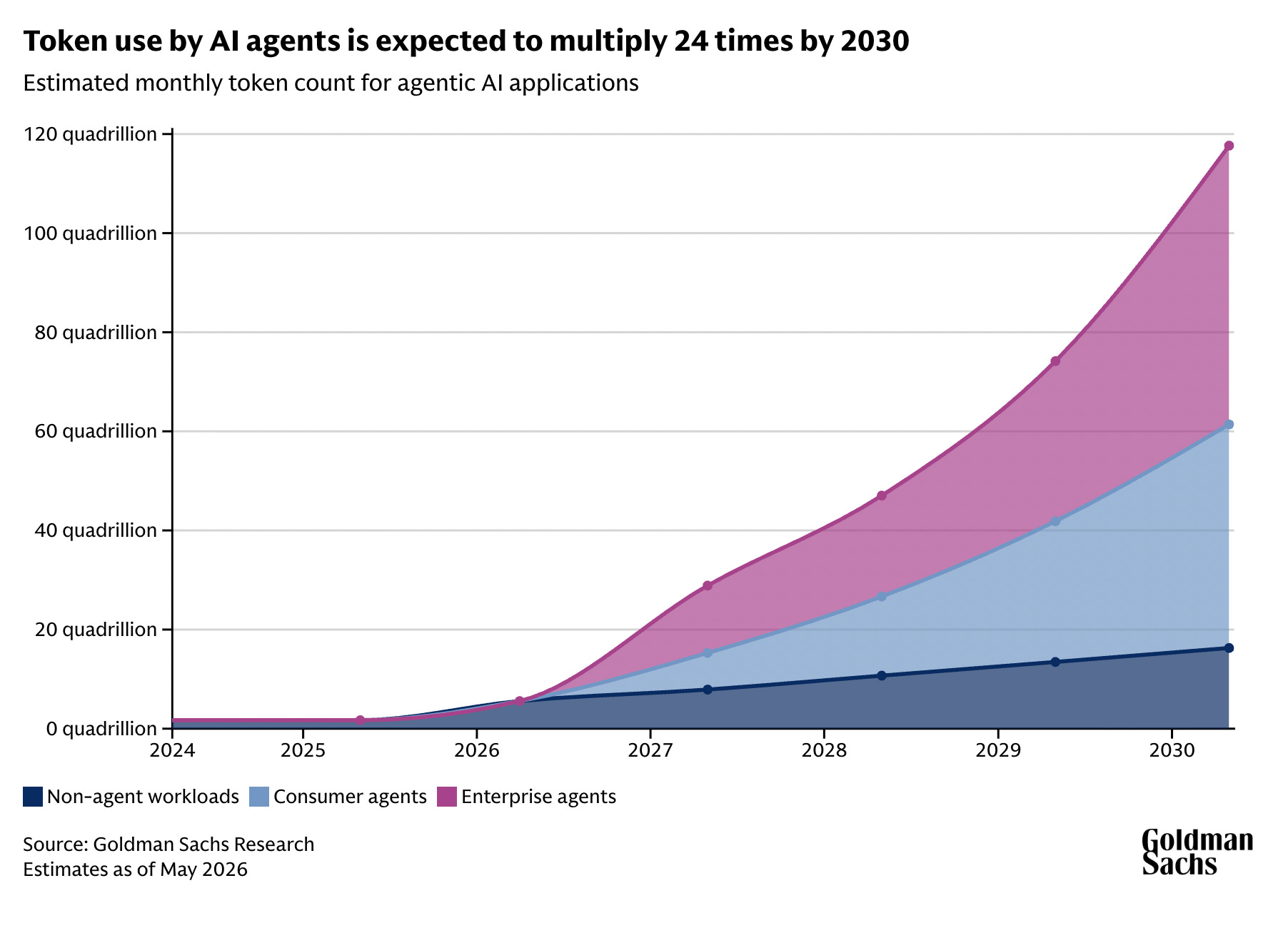
Agentic AI is expected to drive a 24-fold increase in token consumption by 2030 as consumers and enterprises adopt the technology, according to Goldman Sachs Research.
If agentic systems really do end up driving a dramatic increase in token consumption over the next few years, then the relevant question is not whether more intelligence will be available. It will. The question is what becomes valuable when apparent intelligence is abundant. This changes how education is done and quantified.
Traditional intelligence.
I have always been intrigued by the idea of a PhD and general higher education, not only as a qualification but as a signal. What, precisely, was it measuring?
Historically, sophisticated writing required internalisation, difficulty, sustained comprehension, and enough command of a subject to make connections without external assistance. It is not that people valued thought in the abstract. What they valued was the visible trace of having done the thinking oneself. What institutions used to trust were outward signs that seemed to indicate inward cognition: the essay, the interview, the personal statement, the presentation, the academic voice itself. We now live in a world where a degree could be attained without physically writing anything down.
Creating connections yourself between concepts meant you had reached a certain level of understanding of the subject that you were able to think beyond what already existed in it, but now, if an LLM can take two concepts and combine them using a couple of tokens, humans don’t necessarily need to do this anymore.
And second of all, humans are never tested on the depth of their knowledge anymore. I guess the true intelligence of someone can only be told from having a conversation with them. It’s not like an intelligence that is acquired, and an intelligence that is expressed are the same. It’s two very different things. AI has made acquired intelligence less valuable and expressed intelligence more valuable.
This has made educational systems destabilise, and the consequences are not merely educational. There is a much deeper societal phenomenon we can see online.
The Rise Of Performative Intelligence.
So, maybe this is why we’re leaning towards a more performative generation, because AI itself is performative. It doesn’t know. It doesn’t understand; it simply shows. And maybe this cultural shift has been a result of AI, because before, it really wasn’t there.
Social media already rewards performative intelligence; now, AI industrialises it. People can sound insightful and appear informed to simulate an intellectual identity without much deep engagement with the topic subject.
Take Bella Dane. She has made countless neuroscience videos without any qualification in the field. This isn’t necessarily right or wrong, but it does make you question why bother doing the qualification (outside of a research career), if it is possible to have significantly more of a payoff than the average graduate, without it?
The performance of cognition has become easier to generate than cognition itself.
So why do people value thought itself?
I don’t know. I mean, everyone’s motivated by different things. Many people value thought because knowledge feels safe. I’ve always thought this. If I read a book about skiing, then I know what to expect when I go skiing. If you know more, it’s a kind of a barrier of protection that you have between yourself and the world, because you understand things without ever having experienced them. As Friston’s Free Energy Principle states, knowledge is a way of compressing uncertainty. Prediction reduces anxiety.
This is one of the reasons AI creates such a strange inversion. Access to knowledge increases, but internal certainty does not necessarily increase with it. In some cases, it seems to decrease. Many students today do not feel confident that they can outperform AI based on what they know about their degree (Farrier-Cave, 2025). So, they give all their hard tasks away. If everyone begins to do this, it brings us to the question…
What Becomes Valuable When Intelligence Is Cheap?
So last year, I had a really big interest in what taste is made up of, because it’s probably the most abstract concept I’ve ever heard of. And taste comes from time, it comes from refinement. I’d say it’s like learning a language. You can learn a language and know how to do everything one specific way, but there are synonyms. There are phrases, there are idioms, right? How I would define taste is being able to decide not only what fits for what occasion, but what is the most ideal thing for said occasion. Some people are tasteful in the way they phrase things. Other people are tasteful in the way they dress. It is the ability to recognise what fits, what lasts, what matters, and what is merely attractive in passing.
And taste usually comes from:
exposure,
reflection,
lived experience,
iterative refinement,
accumulated error correction.
…which includes learning new things and thought.
The same is true of discernment more broadly. In a world flooded with information, the ability to detect nonsense may become more valuable than the ability to produce more content. It’s called a bullshit detector.
It was sitting down with Tracey Rob Perera, a former KPMG Director and experienced tech investor and operator in London’s startup ecosystem, where I first learnt its importance. When information is abundant, judgment becomes the rarer faculty.
This brings me back to the book.
Reading Still Does Matter.
Books aren’t just blocks of information. They are experiences in a writer’s thought process, an expert in said field. Deliberate exposure to a subject like this equips you with taste and discernment. Of course, this doesn’t apply to AI books, but to see a writer’s thought process in the way they phrase things makes you follow their train of thought and ask questions along the lines of the ones they ask. A summary can give you the conclusion, but it cannot reproduce that gradual reorganisation. It cannot mimic the slow change in perceptual structure that happens when you live inside an argument for long enough.
And you’re able to then come back to your personal database of information and link that to what you might have already read. Yes, not everything is going to be fascinatingly interesting, and that’s one thing that AI has set unrealistic expectations for. Reading strengthens the capacity to stay with a thought after its immediate novelty has worn off. It forces a different relationship to friction.
Don’t get me started on friction.

Friction is necessary for meaning. I would say books have innate friction in them, because not every chapter is going to be for you, but having read every chapter, you will understand the bigger picture in a much more cohesive way.
I could write a book about friction, but here are some things you might want to look into if you are interested in the topic:
In social psychology, effort justification describes the tendency to value something more when we have had to work hard for it (Harmon-Jones et al., 2020).
In learning sciences, Robert Bjork’s idea of desirable difficulties suggests that effortful learning can improve later retention and transfer.
Csikszentmihalyi’s flow theory points in a similar direction: people often value activities that demand enough skill and concentration to fully absorb them, because that level of engagement is intrinsically rewarding. I made an animation explaining its neuroscientific backing here.
The same logic also helps explain hedonic adaptation, the tendency for people to return toward a baseline level of happiness after positive or negative changes, which means outcomes alone do not carry their initial emotional charge for very long (Armenta et al., 2014).
Essentially, it has been proven time and time again that humans often value things partly because they require friction to attain.
What everyone says and what I don’t care to hear.
Yes, we will see a rise in cognitive obesity - straight up junk consumption through doomscrolling and very little retention. In a world where intelligence is abundant, the scarce resource may become the ability to metabolise information meaningfully. Discernment. Taste. Depth. Boringgg.
Cognitive Ownership is the real goal.
What AI cannot give someone is the psychological memory of becoming capable. To see that you are able to create your own connections between two pieces of knowledge means that you’re probably more qualified to act on it than any AI would.
It can provide the answer, but it cannot supply the residue of effort. This is the self-trust that accumulates when you have endured opposing opinions, the absolute rollercoaster of emotions reading your badly written draft, and the hopelessness of having written something no one wants to read. When your weak, vague thoughts are revised into stronger ones, and when you saw something through before you were certain you could… that residue matters because it compounds. It becomes intuition, confidence, discernment, and eventually a kind of earned authority over your own mind.
This is why cognitive ownership may become one of the rarest and most valuable things in an age of abundant intelligence. Ownership as lived synthesis.
The fact that you arrived at a thought through your own effort changes your relationship to it. You are more able to act on it, defend it, adapt it, and recognise its limits. It belongs to you in a way that outsourced conclusions never fully can.
The point of doing difficult things was never just to produce the answer. It was to become someone capable of producing answers.
Thank you for reading.
P.S. Humans will always prefer humans. Humans naturally search for signs of real cognition underneath expression (Jastrzab et al., 2024). Ironically, over time, AI will make that even more valuable.
References:
Armenta, C., Bao, K. J., Lyubomirsky, S., & Sheldon, K. M. (2014). Is lasting change possible? Lessons from the hedonic adaptation prevention model. In S. Lyubomirsky & K. M. Sheldon (Eds.), Stability of happiness (pp. 57–74). Academic Press. https://doi.org/10.1016/B978-0-12-411478-4.00004-7
Dadds, K. (2025, February 26). The ancient origins of “manifesting”—and why it’s making a comeback. National Geographic. https://www.nationalgeographic.com/history/article/the-ancient-origins-of-manifesting
Goldman Sachs. (n.d.). AI agents forecast to boost tech cash flow as usage soars. https://www.goldmansachs.com/insights/articles/ai-agents-forecast-to-boost-tech-cash-flow-as-usage-soars
Harmon-Jones, E., Clarke, D., Paul, K., & Harmon-Jones, C. (2020). The effect of perceived effort on reward valuation: Taking the reward positivity (RewP) to dissonance theory. Frontiers in Human Neuroscience, 14, 157. https://doi.org/10.3389/fnhum.2020.00157
Jastrzab, L. E., Chaudhury, B., Ashley, S. A., Koldewyn, K., & Cross, E. S. (2024). Beyond human-likeness: Socialness is more influential when attributing mental states to robots. iScience, 27(6), 110070. https://doi.org/10.1016/j.isci.2024.110070
Wonkhe. (2025, April 28). What does it mean if students think that AI is more intelligent than they are? https://wonkhe.com/blogs/what-does-it-mean-if-students-think-that-ai-is-more-intelligent-than-they-are/
Credit to Roy Lichtenstein for the cover photo.
Very well written. I'm writing something similar. Would love to know your views on it -
https://substack.com/home/post/p-201410932
CITATIONS??!! Amen… :)